
 0



- Home
- Blog
- Technical Insights
- What Is a Brushless Motor? A Quick Guide to Working Principles, Control, and Applications!
What Is a Brushless Motor? A Quick Guide to Working Principles, Control, and Applications!
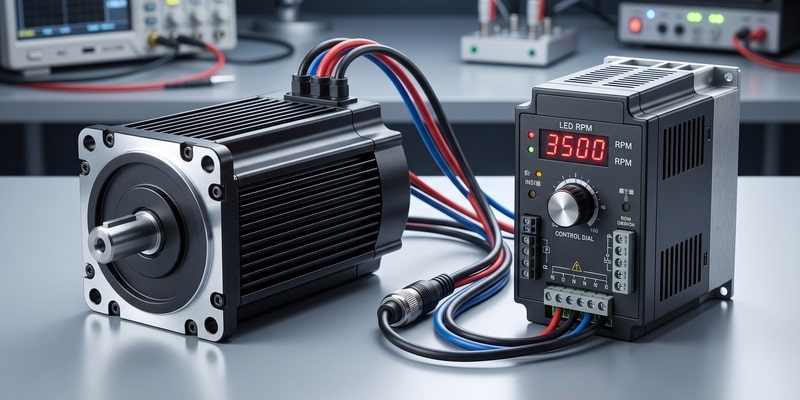
A brushless motor uses an electronic drive circuit instead of carbon brushes and a commutator, switching the stator phase currents according to rotor position to create a continuously rotating magnetic field. These brushless motors are found in electric vehicles, drones, pumps, factory conveying, glass edging grinding machine, Centrifugal equipment, Polishing equipment, Emulsifying machine, screen printing machine and Package conveying machine. However, in practical implementation, the ac driver, feedback components, gearbox, load inertia, and heat dissipation conditions must also be evaluated to determine whether efficiency, speed, and control accuracy meet equipment requirements. The following provides an overview of brushless motor operating principles, differences from brushed motors, common types, and applications.
How Does a Brushless Motor Work?
A brushless motor consists primarily of a stator, rotor, bearings, position-sensing components, and a drive circuit. When the stator's multiphase windings are energized sequentially, they generate a rotating magnetic field that AC drives the permanent-magnet rotor to rotate synchronously. The driver switches the current in each phase through power transistors and uses Hall sensors, encoders, or back-EMF to estimate rotor position. By adjusting the energization sequence, frequency, and current, the system can control starting, stopping, forward and reverse rotation, speed, and output torque.
How Do Brushless and Brushed Motors Differ?
The greatest difference between brushless motors and brushed motors is the method of “commutation”. Brushed motors change the current direction through physical contact between carbon brushes and a commutator, whereas brushless motors perform electronic commutation via a driver. The driver must know the rotor's current position to determine when to switch the current, and there are two sources of position information: one is a Hall sensor, which provides higher accuracy and more stable low-speed control, while the other uses sensorless control based on back-EMF detection, but at low speeds, it may be more difficult to accurately determine the rotor position.
Brushless Motor & Brushed Motor Comparison Table
| Item | Brushless Motor | Brushed Motor |
|---|---|---|
| Commutation Method | The AC drive performs electronic commutation | Mechanical commutation by carbon brushes and commutator |
| Control Requirements | Requires a built-in or external drive circuit | adjust speed-control circuitry is simpler |
| Maintenance Items | Inspect bearings, cooling, and wiring | Inspect carbon brushes and commutator wear |
| Noise and Sparks | No brush friction or commutation sparks, but electromagnetic and bearing noise remain. | Brush friction noise and sparks may occur. |
| Speed and Control | variable speed range and closed-loop control | Easy speed adjustment, but accuracy is affected by the controller and load. |
| Initial Cost | overall cost for motor and drive is higher | Simple structure, with lower initial implementation costs. |
| Applicable Scenarios | Continuous Operation, Automation, Precision Control, Low-Maintenance Equipment | Cost-Sensitive, Simple-Control, or Short-Duration Operating Equipment |
(Swipe left or right to view the full table)
Why Are More and More Devices Using Brushless Motors?
When the magnetic circuit, winding, driver, control algorithms, and thermal design of a brushless motor are properly matched, equipment can reduce friction losses and maintenance requirements while achieving a wider speed-control range within a stable output. The following summarizes the advantages of a complete brushless motor system, helping you better evaluate the complete drive system.
High Energy Efficiency
Brushless motors have no carbon-brush friction and do not incur additional heat losses caused by carbon-brush contact resistance. Compared with conventional brushed motors, whose energy conversion efficiency typically ranges only from approximately 55%–75%, brushless motors can achieve substantially higher system energy conversion efficiency of over 85% when properly matched in terms of size, load, and operating point, and the input electrical energy can be converted more effectively into mechanical output, reducing power consumption and temperature rise in continuously operating equipment.
However, the driver also generates switching and conduction losses. When selecting a model should compare the entire efficiency curves of the brushless motor and driver rather than considering only the motor efficiency.
Low Maintenance and Long Service Life
Brushless motors do not require regular carbon-brush replacement, reducing downtime for disassembly and reassembly, carbon-dust cleaning, and commutator inspection. They are suitable for equipment that is difficult to access or require continuous production. Actual service life is still affected by bearing lubrication, winding insulation, magnet temperature, vibration, and dust, as well as driver electronic components, and may operate for 10,000–30,000 hours or even longer. Compared with the service life of brushed motors of approximately 1,000–5,000 hours, the difference is considerable. If the equipment also includes oil seals, fans, brakes, or gear reducers, these must also be included in the maintenance plan to extend the lifetime.
Low Operating Noise
No carbon and commutator friction, a brushless motor operates more quietly, making it suitable for environments requiring quiet operation, such as medical equipment or laboratory instruments, and reducing the impact of mechanical noise on work. However, brushless motors still generate a little bit bearing noise.
Speed control and torque control adjustment
The speed and torque of a brushless motor can be controlled through a drive, and, when used with Hall sensors or sensorless control technology, can provide stable speed adjustment, direction control, and start-stop operation. For conveying, metering pump and indexing tables, rock drills, laboratory centrifuge, grinding and polishing machine as well as lawn mowers, in addition to the brushless motor, it is also necessary to verify encoder resolution, control-loop response, load inertia, and planetary gearbox backlash to achieve the required control performance.
Easier Equipment Miniaturization and Intelligence
Because brushless motors do not require space for brushes and commutators, they can be made smaller than brushed motors with the same power output, and as technology for integrated drive-control chips continues to mature, they can provide the required output within limited space, reducing the motor installation size of equipment. This offers significant advantages for compact, lightweight consumer products and automation equipment requiring multi-axis configurations, providing substantial benefits.
What Types of Brushless Motors Are Available?
The following introduces common types of brushless motors. When selecting a motor, be sure to confirm the motor waveform, rotor position feedback, and drive method, as well as the speed, position, or torque control mode.
BLDC Motor (Brushless DC Motor)
BLDC is an abbreviation for Brushless Direct Current Motor, or brushless DC motor. BLDC motors have trapezoidal back EMF and commonly use six-step commutation control, with Hall sensors or back-EMF detection to determine commutation timing. Their control logic is simple, and their efficiency is high, so they are widely used in fans, metering pumps, machine tools, and drones. However, because BLDC motors have relatively high torque ripples, users may experience slight cogging during operation.
〈Related Articles: How to Choose a Brushless DC Motor: BLDC Motor Principles, Advantages, Limitations, and Applications〉
AC Brushless Motor
A brushless AC motor refers to a system in which AC power is supplied to the driver, which then converts it into multiphase current suitable for the motor, rather than a standalone electromagnetic structure, and can directly use the existing AC power supply in a facility. It is suitable for conveyors and packaging machines using 110VAC, 220VAC, 380VAC, or 440VAC power supplies in factories, as well as food equipment, reducing the need for additional DC power supplies.
PMSM (Permanent Magnet Synchronous Motor)
PMSM stands for Permanent Magnet Synchronous Motor and features back EMF that more closely approximates a sine wave, together with sinusoidal control or field-oriented control (FOC), and, compared with BLDC motor, it provides smoother torque output and lower operating vibration, making it suitable for low-noise, high-efficiency, high-precision, and dynamic-control industries.
Brushless Servo Motor
Brushless servo motors are typically equipped with encoders or resolvers. The driver forms a closed-loop control system based on the error between the command value and feedback value, enabling position, speed, or torque control. The motor itself may use BLDC or PMSM technology; therefore, a servo system is primarily defined by its control system and feedback capability, and is commonly used in positioning conveyors, processing equipment, capping machines, vacuum packing machines, screen printing machines, CNC digital grinder machines, engraving machines, glass edging grinding machines and other automation equipment requiring repeatable positioning.
〈Related Articles: Analyzing the Future Trends of Industrial Motors and Electric Vehicle Technologies〉
What Are the Applications of Brushless Motors?
Brushless motors can be used in rotation, conveying, metering pumps, ventilation, positioning, and electric vehicle traction, but different industries prioritize different voltage, torque, cleanliness, protection rating, and safety requirements. Below, we will introduce several common brushless motor application areas.
Automotive Industry
Brushless motors are increasingly used in two-wheeled electric vehicles. They can drive cooling fans, liquid pumps, HVAC blowers, electric auxiliary systems, and traction systems, while also meet vibration, temperature, electromagnetic compatibility, and functional safety requirements. Fans and pumps prioritize efficiency, noise, and durability, while E-vehicle traction motors can handle high torque at low speeds, low torque at high speeds, a wide speed range, regenerative braking, and thermal management. Electric vehicle traction motors mostly use IPM motor configurations to achieve high efficiency and a wide speed range.
Food Machinery and Biotechnology Processing Equipment
Brushless motors can be used in food machinery (such as vegetable cutter machine), vacuum packaging machines, emulsifying machines, and coffee bean roasting machines, and these applications place particular emphasis on clean operation free of carbon dust contamination, low temperature rise during prolonged operation, and multi-speed control, so motor housings for food-grade equipment must provide water resistance and dust resistance, to withstand routine cleaning operations.
Industrial Automation
Industrial automation equipment, including CNC lathes and milling machines, grinding/polishing machines, conveyors, plastic injection molding machines, and industrial mixers, relies on precisely controlled electric motors. Brushless motors offer high efficiency and long lifetime, making them a mainstream choice in industrial automation. Paired with drives, they enable smooth control, and in processing equipment requiring multi-axis synchronization, brushless motors' closed-loop control capabilities are especially important.
Medical Equipment
Medical equipment such as blood-analysis centrifuges requires a high-speed BLDC motor that is quiet and reliable, and the advantages of brushless motors align perfectly with these requirements. In addition, brushless motors do not generate carbon dust, which is also an important consideration in medical environments that must maintain cleanliness.
Laboratory Equipment
Centrifuges, shakers, mixers, vacuum pumps, and precision stages require prolonged operation, stable speeds, and low noise. Taking centrifuges as an example, in addition to maximum speed, rotor inertia, sample weight, acceleration and deceleration time, imbalance detection, and braking method must also be verified, as well as overspeed protection. If selection is based solely on the motor's no-load speed, changes in load may result in insufficient acceleration, overheating, or abnormal vibration.
Green Energy Industry
Solar panel tracking systems, energy storage system cooling equipment, wind power equipment auxiliary mechanisms, and energy-efficient pumps prioritize long-duration operating efficiency, outdoor protection, remote monitoring, and energy consumption, and therefore all use brushless motors. Motors used outdoors must have a sufficient protection rating to withstand sun exposure, rain, and temperature variations.
Brushless Motor Application Comparison Table
| Application Area | Common Equipment | Requirements | Control Solution |
|---|---|---|---|
| Automotive Industry | E-vehicle Traction, pumps, fans, and auxiliary systems | Power density, low-speed torque, wide speed range | BLDC or PMSM Drive |
| Food Machinery and Biotechnology Processing Equipment | Vegetable Cutting, Packaging, Emulsifying, Conveying, and Coffee roasting equipment | Multi-Speed Control, Low Contamination, Washdown Resistance, and Protection | Brushless Speed Control or Closed-Loop Speed Control |
| Industrial Automation | Conveying, Packaging, Processing, and Material Handling Equipment | Constant Speed, Simple Positioning, Timing, and Communication | Brushless Speed Control or Open/Closed Loop |
| Medical Equipment | Centrifuges and Pumps | Low Noise, Cleanliness, and Stability | BLDC, PMSM, or Servo Motors |
| Laboratory Equipment | Lab Centrifugal, Stirring, and Vacuum Equipment | Stable Speed, Low Vibration, and Continuous Operation | Constant-Speed Closed-Loop Control |
| Green Energy Industry | Solar Tracker Systems, Cooling, Pumps, and Auxiliary Drives | Efficiency, Weather Resistance, and Remote Monitoring | Variable-Speed Control and Communication Drives |
(Swipe left or right to view the full table)
How to Choose a Brushless Motor?
When selecting a brushless motor, you should first understand the load and operating conditions, then verify whether the motor, drive, and feedback components, and planetary gearboxes can operate together. If you compare only rated power or maximum speed, it is easy to overlook low-speed torque, acceleration/deceleration current, and temperature-rise limits.
- Load Torque and Inertia: Calculate continuous torque, starting torque, and acceleration torque, as well as external load inertia.
- Speed and Duty Cycle: Confirm the minimum, rated, and maximum speeds, as well as the time proportions for continuous operation, intermittent operation, acceleration/deceleration, and emergency stops.
- Power Supply Specifications: Verify the voltage, number of phases, and frequency of the DC bus or AC input and capacity.
- Control Mode: For positioning, synchronization, or tension applications, evaluate position and speed control & torque control and multi-axis coordination functions.
- Feedback and Accuracy: Select Hall sensors, incremental encoders, or other position feedback components based on low-speed performance, positioning error, and response time.
- Speed Reduction and Transmission: Confirm the reduction ratio, output torque, efficiency, backlash, and radial and axial loads.
- Environment and Installation: Verify the overall dimensions, shaft diameter, flange, ambient temperature, cooling method, dust, moisture, cleaning and IP protection requirements.
- Drive Compatibility: Check rated and peak current, position signals, control interfaces, and communication protocols, as well as overcurrent, overtemperature, overvoltage, and stall protection.
High-Efficiency and Smart Brushless Motors from ADLEE
Founded in 1974, ADLEE has extensive experience in electronics, electrical engineering, and motor R&D and has obtained ISO 9001 and UL certifications. Its products include brushless motors, brushless servo motors, drivers, electric vehicle traction modules, and other products, serving industrial equipment, electric vehicles, food machinery, biotechnology processing, and other applications. ADLEE's brushless motors use electronic commutation and neodymium-iron-boron magnet designs, offering compact size, high torque, high efficiency, and low electromagnetic interference as well as no need for carbon-brush maintenance, making them suitable for equipment with large variations in load and speed. When paired with drivers, they can reliably control the speed, helping businesses improve equipment performance and energy efficiency.
〈ADLEE Brushless Motor Recommendations: Match servo motors, Brushless Motor and Drive, Brushless Motor and Drive〉
Brushless Motor FAQ!
Q1. Must a brushless motor be paired with a drive?
Yes, a brushless motor cannot operate when connected directly to a power supply; a drive is required to control current switching in the stator windings. The drive receives position signals, performs commutation logic, and regulates speed and torque. Therefore, without a drive, a brushless motor cannot operate properly.
Q2. Can a brushless motor run continuously for extended periods?
Yes, brushless motors have no carbon-brush wear issues and are suitable for extended continuous operation, provided that bearing and heat-dissipation conditions are normal. However, during continuous operation, it is still necessary to monitor motor temperature rise and ensure that the heat-dissipation design is adequate. Additional cooling measures may be required if ambient temperatures are high or ventilation is poor.
Q3. Can a brushless motor adjust speed and reverse direction?
Yes, a drive can adjust speed through the control panel, analog signals, digital terminals, or communication commands, and can change the commutation sequence to achieve forward/reverse operation and start/stop control. Whether stepless speed control, low-speed stability, rapid reversal, or torque limiting is possible depends on motor feedback, drive functionality, load inertia, and the machine's internal safety design.
Q4. Does a brushless motor require sensors when operating at low speed and high torque?
Not necessarily, but if the equipment requires low-speed starting or stable torque output at zero or low speed, priority should be given to using position-sensing components such as Hall sensors and encoders, because conventional sensorless control generally uses back EMF to determine rotor position, and the signal is weaker at low speeds or when stationary, making it more difficult to precisely determine rotor position and commutation timing.
Q5. What Is the Difference Between Brushless Motors with and Without Sensors?
Sensor-equipped brushless motors use Hall sensors, encoders, and other components to detect rotor position; therefore, they provide more stable control performance during startup, low-speed operation, and load changes. Sensorless systems typically use back electromotive force to estimate rotor position, reducing sensing components and wiring and resulting in a relatively simplified structure. They are commonly used in applications such as fans and pumps that primarily operate at medium to high speeds.
Conclusion
Brushless motors use electronic commutation in place of mechanical commutation and outperform conventional brushed motors in efficiency, service life, noise, and control precision, but require a driver to operate. When selecting a motor, torque, speed, control method, environmental conditions, and driver compatibility must all be considered. ADLEE offers brushless motors in a variety of specifications and other drive solutions that meet business needs in accordance with international standards. Please contact us today to learn more about motor applications.

ADLEE
Adlee focuses on motor and drive innovation, delivering reliable, high-quality solutions that meet international standards and support diverse applications.


Article Classification
Recent Articles
- IE3 vs. IE4 Motors: Efficiency, Energy Use & Selection
- What Is a Brushless Motor? A Quick Guide to Working Principles, Control, and Applications!
- How to Choose a Brushless DC Motor: BLDC Motor Principles, Advantages, Limitations, and Applications
- Analyzing the Future Trends of Industrial Motors and Electric Vehicle Technologies